Against the backdrop of a metaphorical
and fantastic Dark Continent, the narrator (named N) of Norman Lock’s
novel entertains visits from Freud, Einstein, Prince Kong (before the
whole Fay Wray episode), Edison, Darwin, Melies, Houdini, Curie, Wells,
Woolworth, Ziegfield, Stravinsky, and the Wright brothers. Among others.
All, N included, come to Africa with sorted purposes, but most are feeling
the anxiety and fear of the era, right before World War I, when dramatic
possibilities are everywhere and drastic change is inevitable.
Time and space and other annoyances of reality
go out the window as Lock bends and stretches objective interpretations
of historical events and figures for the sake of more imaginative and
entertaining possibilities. A vast endeavor, certainly, but the ease and
consistency with which he creates the chaos makes for a wonderful analysis
of reality or history, without overwhelming the reader with feelings of
manipulation. Instead, this book is fun, and funny.
Thematically, of course, we can see that
the individuals who show up in Mombasa are innovators/challengers of certain
laws of reality around them, whether they regard flight or commerce or
physics or science; all test the status quo and open up new perceptions.
And the conversations and interactions of these individuals are what give
the book its humor: Albert Einstein tries to teach the natives math when
they only want to know the “sorrowing” (the sadness that comes
from his violin playing), Freud meets Teddy Roosevelt at the Mombasa bar
where they square off about fresh air to cure hysteria, Dale Carnegie
shows up seeking to give the gift of his enthusiasm. N himself plays a
combination ringleader and devil’s advocate, as seen when he argues
with H.G. Wells about fiction:
“I, too, am writing a history:
A History of the Imagination.”
“What’s in it?” he asked.
“Everything that’s not in
yours,” I taunted him.
“Then it’s a lie!” he
said with a vehemence I thought extreme.
I retaliated: “Mine is a history
of possibilities . . .”
“I do not understand you.”
I pointed to the steamer which by now
had entered the bay.
“The boat will sink, or not—depending,”
I said. “You write the history that lies in its wake while I write
of its possible encounters with the unknown. In this, mine is a history
of the future. Like your Time Machine or War of the Worlds.”
Wells stopped his pacing of the narrow enclosure to shout his indignation
at me: “They are fictions!”
“But no less real for their being
so.”
“You’re a lunatic!”
“Time is richer than you suppose,”
I said. “You imagine it as a succession of singular moments like
a string of pearls. I see it as . . .”—I hunted for a suitable
image with which to convey the dizzying complexity of time and settled
on the firmament—“as the night sky with its countless stars.”
He beat the air with his fists in a perfect fury.
Certain references might be tough for some
readers: Raymond Roussel, for example, who is exasperated that it will
be another hundred years before “they” will learn to read
him (it’s 1910). Stated, this is not the type of book your random
reader might pick up (if only!), but with the right openness to the liquid
borders of time and space and reasoning, anyone can get into the literal
happenings. Lock’s wit is outstanding; he’s created conversations
with historical figures and made them better than reality could offer,
but resists acting like he’s going for the laughs. Part of the success
may be due to the fact that while there is a wide parameter of flexibility
required of the reader, there is never an imposition of heavy-handedness.
In addition, the history of A History
of the Imagination itself replicates themes of the text; parts of
it have already appeared in 40 journals and each part exists as a complete
story on its own. In an interview on the FC2 (publisher) website, Lock
refers to the origin of the pieces as an experiment with the Roosevelt’s
African Game Trails with the influence of Roussel’s Impressions
of Africa. Indeed his work shows influence from a range of other
writers (Ionesco, Cortazar, Borges,) and different types of art as well,
yet manages to come out wholly original and with a voice all its own.
Like other of the better “experimental”
fictions, this novel forces the reader to negotiate between reading the
text and reading around, in between, and under the text, analyzing what
Lock’s translating along with what he’s leaving open. Lock,
however, plays even upon this presumption; toward the middle of the novel,
we are transported to the City of Radiant Objects, where “things
are free of the obligation to signify.” Funny, yes, and the reader’s
reaction to reading this is even funnier (excellent, what a relief, now
I can just read and enjoy the fun). Lock’s writing begs us to join
in on the game, becoming a part of these strange possibilities, and lighten
the heavy load a little, or at least shift it around. And like the innovations
referred to in the text, A History of the Imagination may be
proof that new and outlandish perceptions are not only possible these
days, but necessary, inside and outside of fiction. |
Amy Havel’s stories have appeared in Conjunctions, Failbetter, and Pindeldyboz, and are anthologized in The Way Life Should Be: Contemporary Stories by Maine Writers, and Consumed: Women on Excess. She has written for Rain Taxi, Review of Contemporary Fiction, Portland Press Herald, and American Book Review, among other publications.
Norman Lock discovered and edited George Belden's Land of the Snow Men, published in September, 2005, by Calamari Press. Lock's books Émigrés,
Joseph Cornell's Operas, and Grim Tales
have been combined into Trio, available from Triple Press. His
story “In the Tunnels” appeared in Tarpaulin Sky
V2n2&3. |
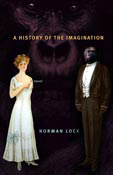 A
History of the Imagination
A
History of the Imagination